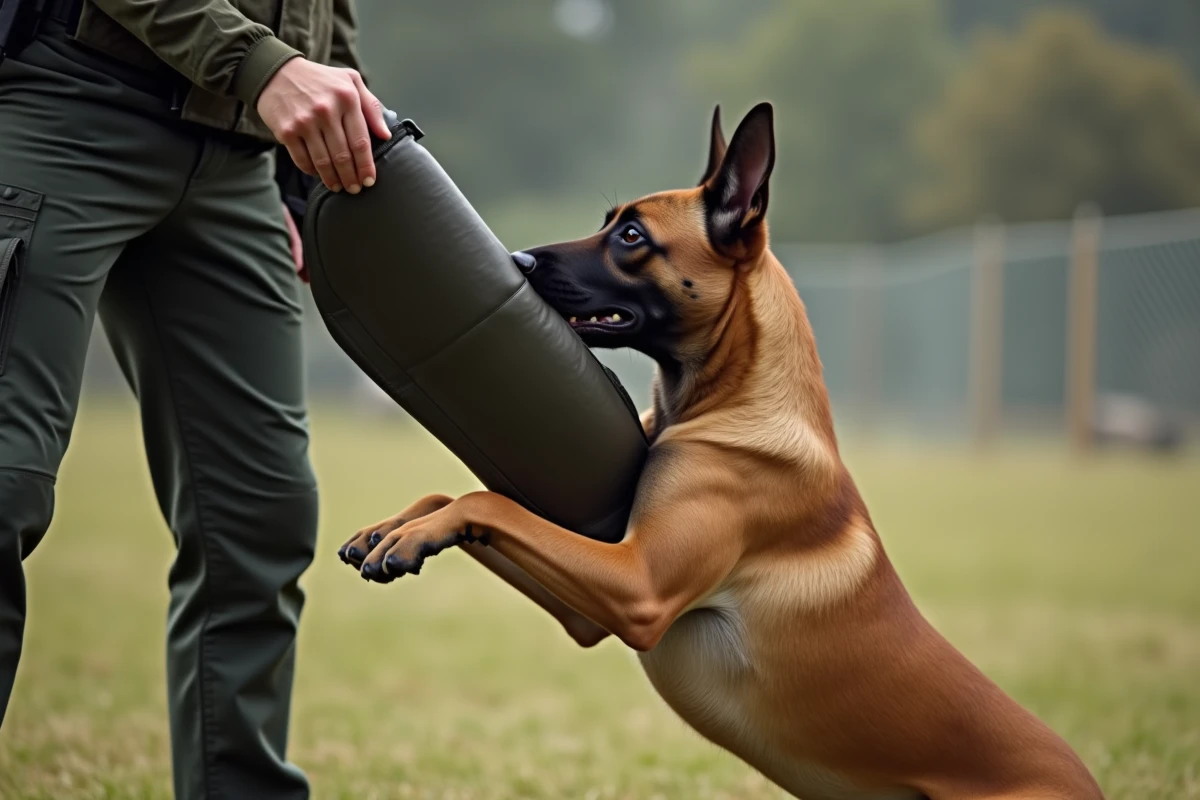
A Malinois catching a bite sleeve during training exerts impressive pressure. This jaw strength fuels many fantasies, sometimes relayed on social media with figures pulled out of thin air. For an owner, understanding what lies behind this power helps to live better with their dog on a daily basis.
Measuring a dog’s bite force: a science less exact than one might think
Have you ever seen breed rankings with values in PSI? These numbers circulate everywhere, but they pose a significant problem: no standardized method allows for comparing breeds with each other.
The measured force depends on the angle of the jaw at the time of the test, the exact point where the pressure is captured, and especially the motivation of the animal. A relaxed dog nibbling on a sensor does not produce the same result as a dog in a situation of stress or excitement. Veterinary publications, notably the works of Schilder and van der Borg, emphasize this point: isolating a raw number tells us almost nothing about the actual risk.
In practical terms, when reading that a Malinois bites at a certain pressure, one must keep in mind that this value varies from one individual to another, from one test to another, and from one laboratory to another. Better understanding the jaw strength of the Malinois first requires accepting that the number alone is not enough to evaluate a dog.
Malinois jaw: what really matters for the owner
Rather than focusing on a pressure value, a Malinois owner benefits from being interested in a much more concrete mechanism: bite inhibition. This is the dog’s ability to modulate the force it applies with its mouth.
This mechanism is learned early. A puppy playing with its siblings receives clear signals when it bites too hard: the play stops, the other puppy yelps. This immediate feedback teaches it to control its pressure. In the Malinois, a breed with a strong motivation for grasping, this learning is particularly crucial.
Early socialization and managing excitement
The AVSAB (American Veterinary Society of Animal Behavior) recommends socialization from the first weeks of the puppy’s life. For a Malinois, this means exposing it to varied contexts (noises, people, other animals) in a positive setting.
A well-socialized Malinois does not bite because it knows how to modulate, not because its jaw is less powerful than another’s. The risk of serious bites is related to behavior, not anatomy.
- The learning of inhibition mainly occurs between 3 and 16 weeks: a puppy separated too early from its litter misses this window
- Mouth games (nibbling on the hand, tugging on a toy) should not be banned but framed: they teach the dog the acceptable limit
- An adult Malinois that has never learned to modulate its pressure poses a much higher risk than a dog of a breed reputed to be “more powerful” but properly socialized
Predatory behavior and reactivity: the real warning signals
The Malinois is a herding dog selected for its reactivity and ability to intervene quickly. This temperament, sought after in security and defense missions, can become problematic in a household that does not understand it.
An under-stimulated Malinois often develops chasing behaviors. It may run after bicycles, joggers, cats, not out of aggression, but because its predatory instinct has no other outlet. This is one of the leading causes of reports for this breed.
Differentiating reactivity and aggression
A dog that barks and pulls on its leash upon seeing another dog is not necessarily aggressive. It may be frustrated, overly excited, or uncomfortable. In the Malinois, the speed of reaction amplifies these manifestations and can scare those around.
To read your dog correctly, one must observe subtle signals: ear position, tail tension, fixed or averted gaze, licking of the nose. Bite prevention relies on reading body signals, well before any notion of jaw strength.
Training the Malinois: structuring physical and mental exercise
The Malinois needs to work. This is not a marketing slogan: it is a dog selected for decades to perform complex tasks. Without suitable activity, it finds its own ways to occupy itself, and the results often displease the owner.
Physical exercise alone is not enough. A Malinois that runs two hours a day but never thinks remains a frustrated dog. The ideal combines both approaches.
- Scent work (searching for objects, tracking in the forest): engages the brain as much as the legs and effectively tires the dog
- Dynamic obedience with varied exercises: the Malinois excels when it must follow commands in a changing order
- Structured canine sports (ring, mondioring, rhythmic obedience): they channel the grasping instinct within a precise framework with rules for release
- Structured calm time: teaching the Malinois to do nothing is also an exercise, often the most challenging for this breed
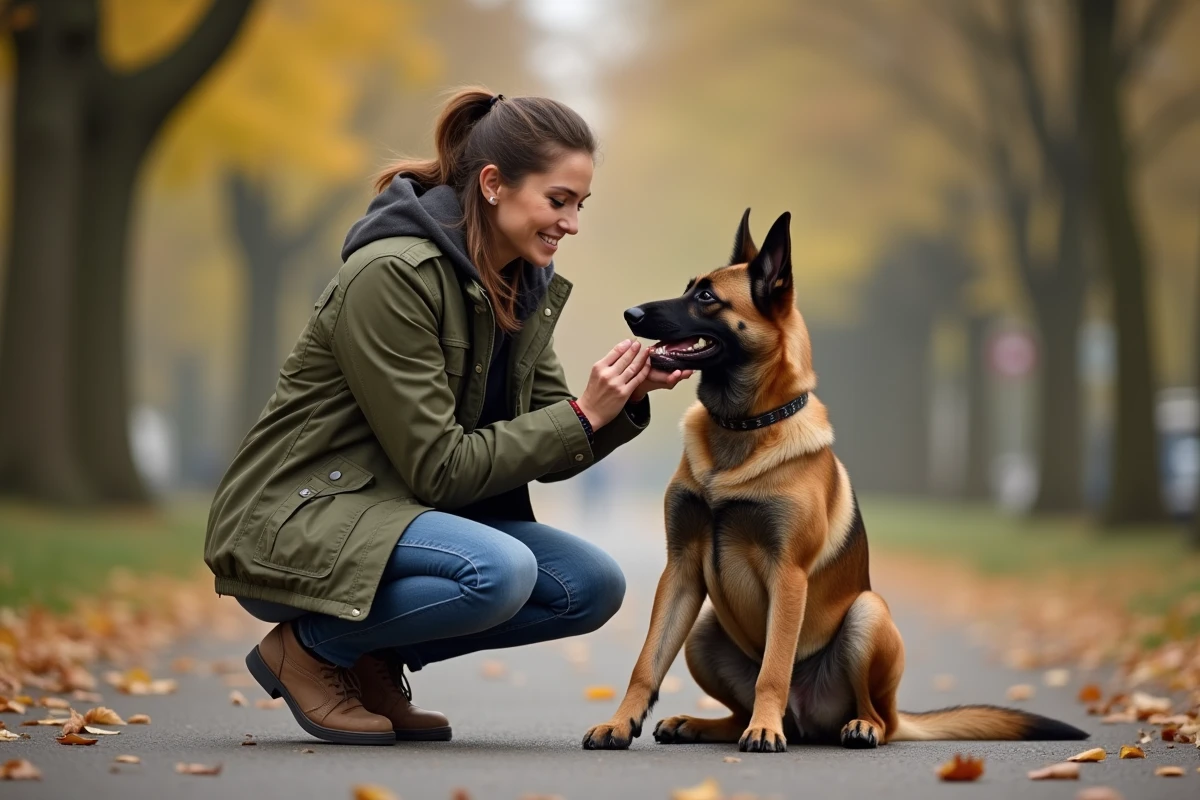
A Malinois that regularly works with its owner rarely poses bite problems. The trust built during these activities reinforces natural inhibition and decreases reactivity.
What abandonments reveal
Canine behavior specialists note that many abandonments of Malinois are linked to a purchase motivated by the image of a powerful and high-performing dog. The gap between this image and daily reality (constant need for stimulation, emotional sensitivity, overflowing energy) leads to unmanageable situations for unprepared owners.
The strength of the Malinois’s jaw is neither a selling point nor a cause for fear. It is one trait among others in a dog whose real challenge lies in the commitment required for family life. An owner who invests in socialization, mental stimulation, and reading their dog’s signals will never need to worry about a PSI number.