
The SST logo refers to the official logo associated with the workplace first aid certification, a program overseen by the INRS. Far from being a mere decorative visual, this symbol adheres to a strict graphic charter and serves an operational function on the ground: allowing employees to quickly identify the person trained in first aid in case of an accident or health issue.
INRS Graphic Charter for the SST Logo: Binding Technical Rules
The SST logo is not free of rights in the sense that a company could modify it at will. The INRS, which manages the training program, imposes specific rules regarding colors, proportions, and safety zones around the symbol. The charter notably defines the exact color values in four-color process, RGB, and Pantone.
For the SST logo at the actor level (the trained employee), the reference colors are a green (Pantone 347, Web 009353), a red (Pantone Red 032, Web E63328), and a blue (Pantone Process Blue, Web 008FD2). The required typography is Gothic 13 Std Regular. These technical specifications prevent any approximation during reproduction on printed or digital media.
The safety zone, calculated from an “X” value derived from the logo’s dimensions, ensures that no external graphic elements encroach upon the logo. This constraint applies equally to a helmet sticker and a training document. A company wishing to affix the workplace first aid logo on its internal materials must adhere to these parameters to avoid distorting the visual identity of the program.
The INRS also distinguishes several levels of logos: SST actor, SST trainer (FOSST), and trainer of trainers (FOFOSST). Each level has its own graphic variation with distinct color codes. The trainer logo, for example, uses a blue-purple (close to Pantone, Web 3E4B9B) and an orange (Web EC6607), with a typography of Source Serif Pro Semibold.
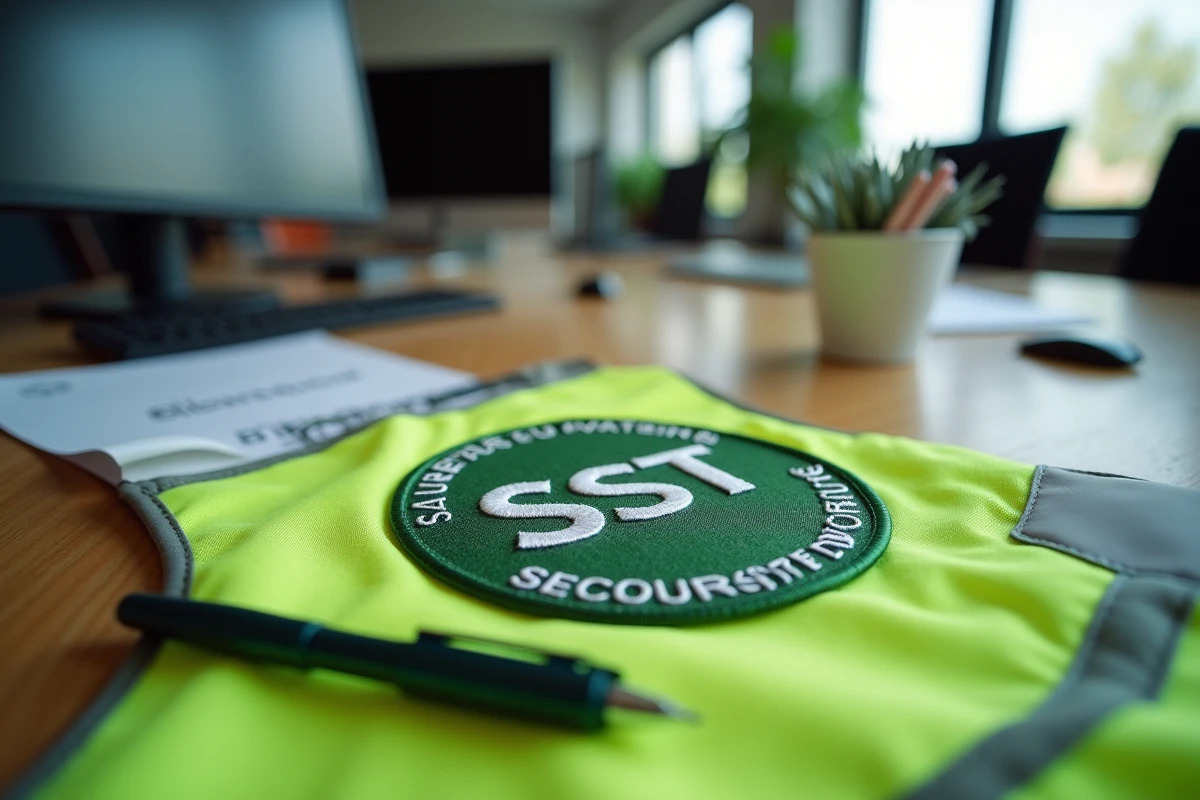
Identification of the First Aider in the Workplace: Sticker, Badge, and SST Badge
The SST logo does not only exist on administrative documents. Its primary function in the workplace is to make the first aider identifiable in an emergency situation. When an employee has a health issue in a workshop or on a construction site, every second counts. The nearest colleague must be able to visually identify who is trained in first aid.
The INRS provides a SST sticker badge to the certified employee at the end of their training. This sticker is not a gimmick: it serves as a functional identification tool issued with the skills certificate.
Beyond the sticker, companies deploy several visibility supports:
- Iron-on or sew-on patches, affixed to work clothing or lab coats, for permanent identification without relying on a removable badge
- Personalized badges incorporating the SST logo, worn around the neck or pinned to the chest, suitable for office or hospital environments
- Textile armbands bearing the SST logo, used during events, evacuation drills, or on sites with high staff turnover
The choice of support depends on the context. An industrial workshop with noise and personal protective equipment requires signage that is visible from a distance. An open space, on the other hand, requires a discreet but readable badge.
SST Logo and Safety Signage: Two Complementary Functions
The logo worn by the first aider does not replace the mandatory fixed signage in the premises. First aid signs (white cross on a green background, compliant with ISO 7010 standards) indicate the location of first aid kits, defibrillators, or assembly points. The SST logo, however, identifies a competent person, not a location.
This distinction has practical implications. A fixed sign remains visible even when the first aider is absent, on leave, or away. In contrast, only the logo worn by the employee indicates, at any given moment, who in the room can intervene. The two systems work together.
Field feedback varies on the actual effectiveness of these markings. In small structures where everyone knows each other, the visible wearing of the SST logo is more symbolic than necessary. In large industrial or logistical sites, with temporary workers and subcontractors changing regularly, the visibility of the logo becomes a real lever for responsiveness in the event of an accident.

SST Certificate and Validity: What the Logo Truly Certifies
Wearing the SST logo implies holding a valid workplace first aid certificate. This certificate is issued by a training organization authorized by the INRS and the Health Insurance – Occupational Risks network. It certifies that the employee has mastered the first aid and occupational risk prevention skills defined in the national reference framework.
The certificate has a limited validity period. Maintaining skills requires a refresher session (called MAC SST) that the employee must attend before the expiration date. An employee whose certificate has expired should logically no longer wear the logo, even if they have completed the initial training. In practice, few companies retrieve stickers or patches from employees who have not been refreshed, creating ambiguity about the reliability of the visual marking.
The employer is responsible for tracking the validity dates of their employees’ SST certificates and organizing refresher sessions. The Labor Code requires each company to have personnel trained in first aid, without setting a specific ratio applicable to all sectors. The presence of the SST logo on a work garment is only valuable if the associated certificate is up to date.
The SST logo acts as a signal of trust among colleagues, provided that the company maintains rigor in renewing skills. An expired sticker on a construction helmet gives a false sense of security, which is worse than the absence of marking. The administrative management of the program directly conditions the credibility of the logo on the ground.