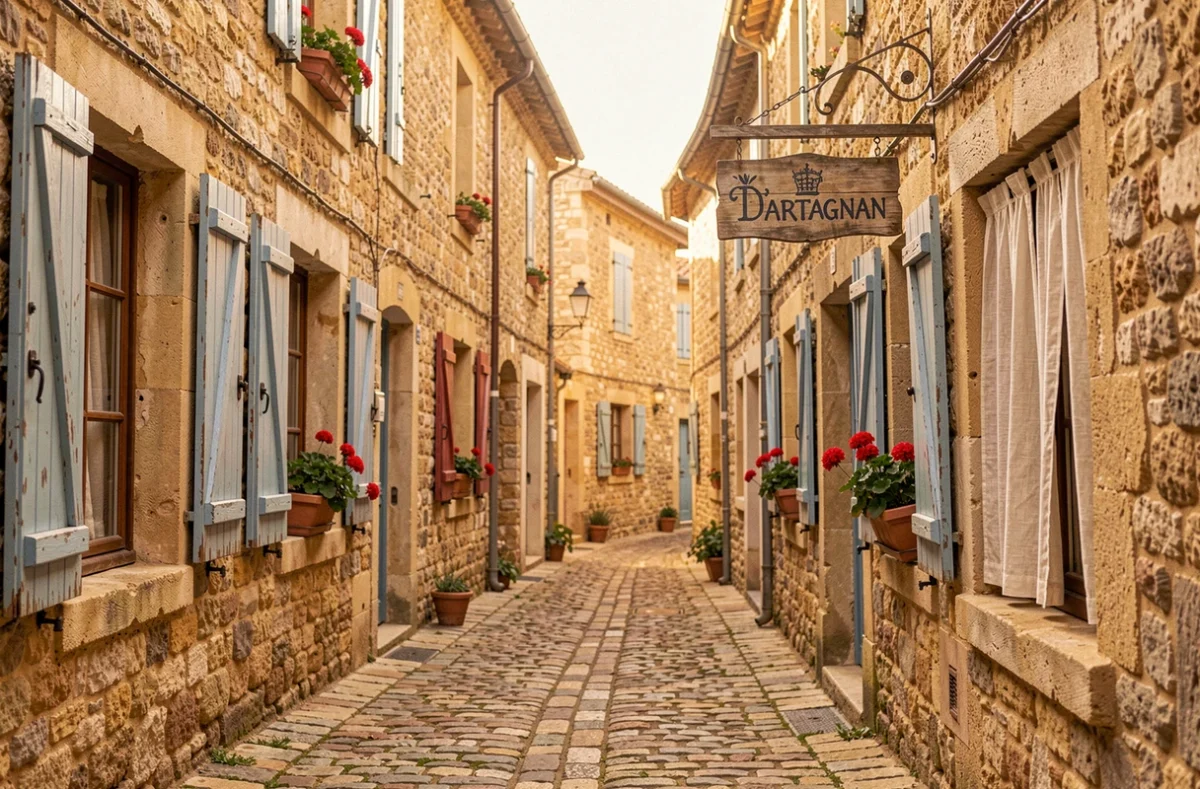
The territory of D’Artagnan in Fezensac lends itself to both historical reading and sensory exploration, between Armagnac cellars and marked hiking trails. Building a travel journal for this part of Gers involves measuring what each type of route concretely offers: distance, density of points of interest, accessibility without a car. This article compares the available exploration formats and analyzes the differences between them to help structure a coherent stay.
Exploration Formats of the D’Artagnan Territory: Comparison by Type of Route
Several tools coexist for traversing Fezensac and its surroundings. The European Route of D’Artagnan offers hiking, equestrian, and cycling routes, with a validation system using stamps recorded in a Musketeer’s Book. The Armagnac and D’Artagnan tourist office provides brochures, city maps, and thematic maps. Finally, packaged stays combine accommodation and guided tours around Vic-Fezensac.
The differences between these formats are not just practical; they condition the very nature of the journey.
| Format | Mode of Transport | Associated Tool | Validation / Reward |
|---|---|---|---|
| European Route of D’Artagnan | Walking, horseback, cycling | Musketeer’s Book | Dartagnane (diploma), Bronze / Silver / Gold distinctions |
| OT Armagnac-D’Artagnan Brochures | Car, urban walking | City maps, magazine, tourist map | None |
| Packaged Stay (Tourism Occitanie) | Car recommended | Pre-established program with accommodation | None |
The Musketeer’s Book introduces a measurable progression logic. Hikers who cover at least 100 km on the D’Artagnan Route receive the Dartagnane, a diploma awarded to those who reach Lupiac (the birthplace of D’Artagnan) or Maastricht. The Bronze, Silver, and Gold distinctions reward 400 km, 800 km, or the entirety of one of the six routes, respectively. This gamified system gives the travel journal both a sporting and cultural tracking function.
Other French territories also organize their routes around historical figures or heritage themes. Visitors who appreciate this structured approach find a comparable logic in destinations like Loire Valley Unpacked, where exploration is based on thematic routes centered around local heritage.
Lupiac and Vic-Fezensac: Two Poles of the Gascon Travel Journal
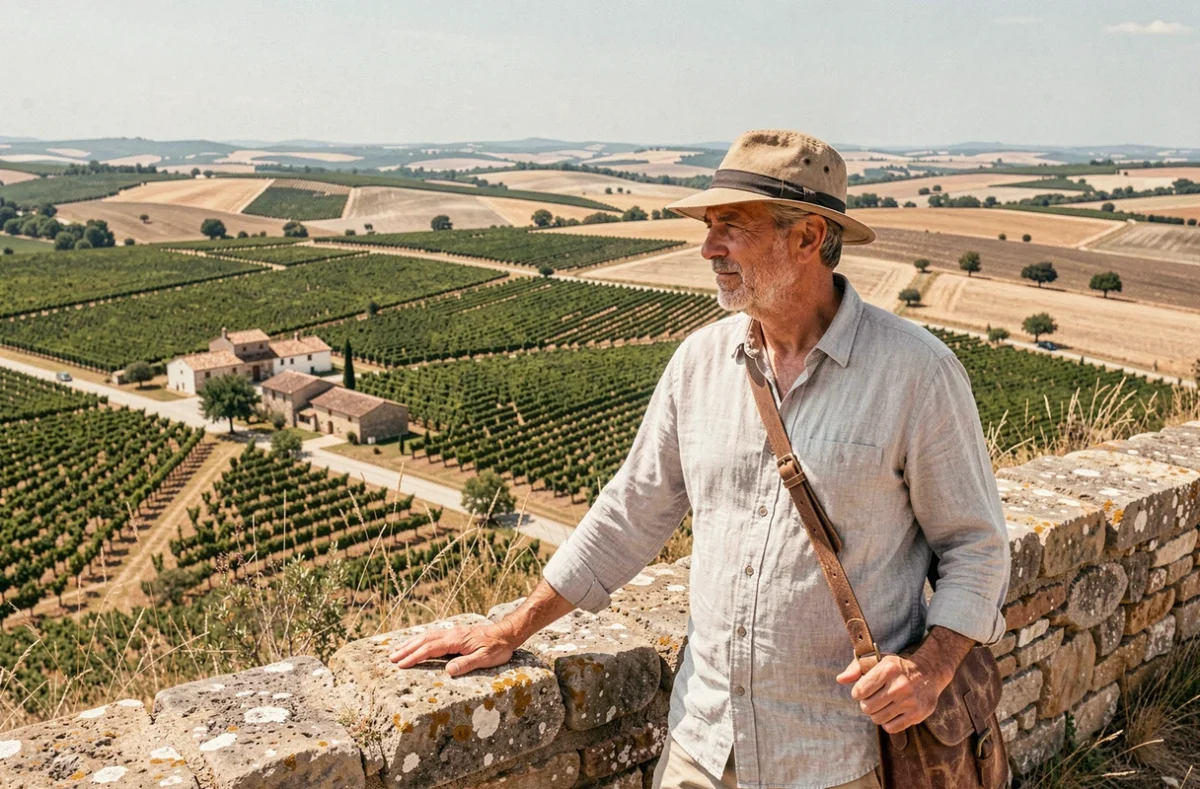
A travel journal in the Gers of D’Artagnan is organized around two distinct polarities. Lupiac, the birthplace of the historical figure Charles de Batz de Castelmore, concentrates the memorial dimension. Vic-Fezensac, on the other hand, functions as a center for services and cultural life.
Lupiac: The Symbolic Starting Point
Lupiac is a mandatory destination to obtain the Dartagnane on the European Route. The village serves as the narrative anchor point for any journal dedicated to the musketeer. Lupiac is the historical birthplace of D’Artagnan, making it a non-negotiable stop for hikers on the marked routes.
The village remains modest in size. A visit takes a few hours, leaving time to reach other stages of the route during the day.
Vic-Fezensac: Logistical and Cultural Base
Vic-Fezensac offers a different profile. The town has an active media library for over ten years, cultural facilities used year-round, and a built heritage in full transformation. An old bodega in the historic center has recently been put up for sale, illustrating the changes occurring in the urban fabric between festive, associative, and residential uses.
Vic-Fezensac combines accommodation, dining, and cultural programming, making it the most functional base for exploring Fezensac. The accommodation L’Encantada, for example, combines a cellar with visits and tastings upon request, allowing for the integration of an Armagnac stop directly into the stay.
Accessibility of Gers Without a Car: A Structuring Parameter of the Journal
The issue of transport radically alters the content of a travel journal in Fezensac. Most packaged stays and brochures from the tourist office assume the use of a personal vehicle. For visitors without a car, options exist but remain limited.
liO buses serve Vic-Fezensac, while the train primarily covers the Toulouse-Auch route. Connections between these two modes of transport and the villages of the territory (Lupiac, Castelnau-d’Auzan, Eauze) depend on schedules and periods. A realistic travel journal must integrate these constraints from the preparation phase.
Three elements to check before planning a car-free itinerary:
- The frequencies of liO lines vary according to the days of the week and school holidays, necessitating the consultation of updated schedules before each stage
- The distance between the nearest bus stop and certain heritage sites can represent several kilometers of walking on departmental roads
- Accommodations located outside Vic-Fezensac do not all offer shuttle or transfer services from the bus station
This observation does not disqualify car-free travel, but it directs the journal towards a slower format, focused on Vic-Fezensac and its immediate surroundings, with planned occasional excursions.
Armagnac and Gascon Heritage: What the Travel Journal Must Document
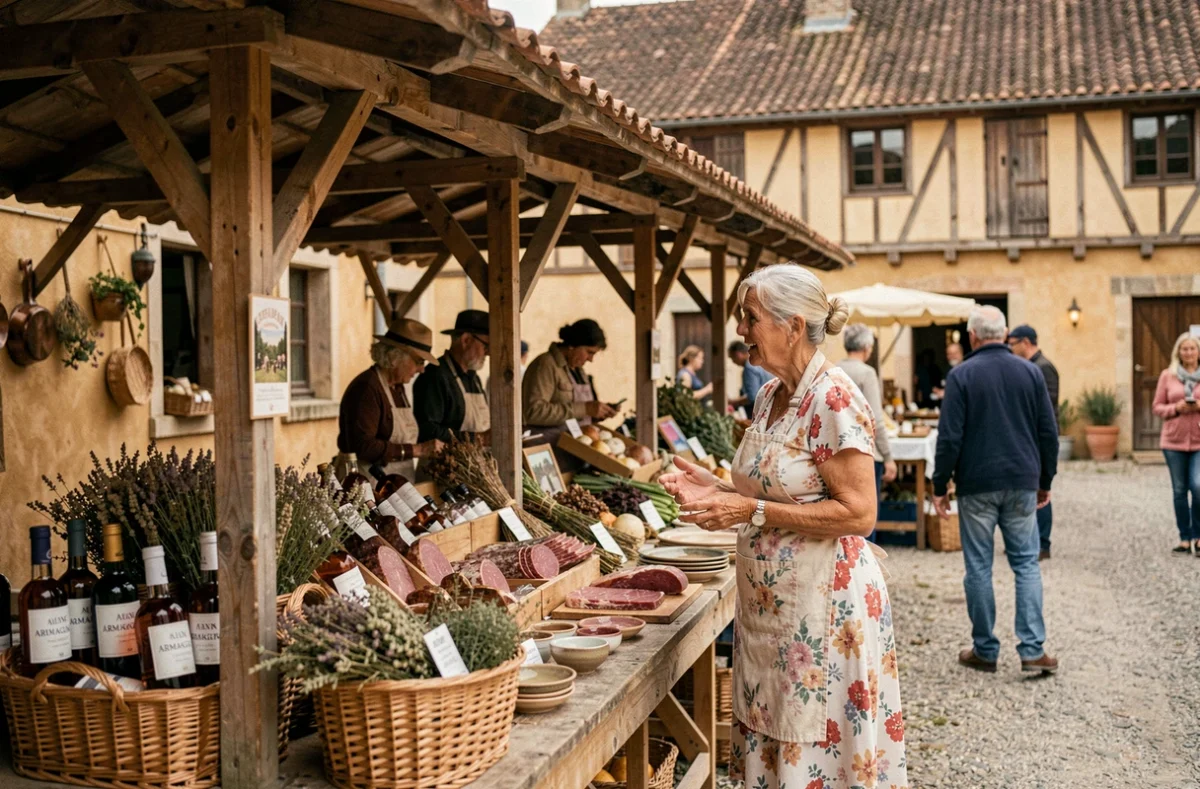
The territory of D’Artagnan in Fezensac is located in the heart of the Armagnac production area. This geographical fact transforms the travel journal into a tool for gastronomic as well as historical documentation.
The cellars open for visits allow for an understanding of the distillation and aging process. L’Encantada in Vic-Fezensac offers tastings upon request, which requires advance booking. Other estates in Fezensac operate on the same principle, with variable visiting slots depending on the season.
What a Useful Journal Should Contain
A travel journal for this region gains value when it goes beyond a simple checklist of places to tick off. Documenting the discrepancies between the expected experience and the reality on the ground makes the journal reusable by other travelers.
- Note the actual opening hours of the cellars and estates, often different from those displayed online, especially outside the summer season
- Record the stamps obtained in the Musketeer’s Book with the date and precise location, to facilitate the request for a diploma or distinction
- Identify the water points and supply stations on the hiking trails, information rarely present in tourist brochures
- Photograph the heritage interpretation panels, whose content is not always reproduced on the websites of tourist offices
The travel journal becomes a field tool when it records what brochures do not mention: a cellar closed on Tuesday, a muddy path after rain, a canceled bus connection during off-peak periods. This practical dimension distinguishes a personal journal from a simple downloaded guide.
European Route of D’Artagnan: The Guiding Thread of the Stay in Gascony
The European Route of D’Artagnan connects several countries and crosses Gers through Fezensac. It serves as the most structuring narrative thread for a travel journal in this area. The six proposed routes cover varying distances, from the local segment of a few dozen kilometers to international crossings.
For a stay limited to a few days in Fezensac, the Lupiac-Vic-Fezensac segment concentrates the Gascon identity of the route. It allows for the combination of a visit to the birthplace of D’Artagnan with a city stop, without requiring a sporting commitment over several hundred kilometers.
The distinction system (Bronze, Silver, Gold) encourages successive returns to the territory. A first stay can serve to mark the stages of Fezensac, while a second will allow for expansion towards Eauze or Condom. The travel journal then functions as a cumulative logbook, enriched over the course of stays in Gascony and Occitanie.
The territory of D’Artagnan in Fezensac provides enough material to fill a dense journal over three to five days. The main constraint remains transport: with a car, the journal opens up to the entire Armagnac country; without a vehicle, it tightens around Vic-Fezensac and its direct connections. In both cases, the Musketeer’s Book remains the most concrete travel companion to structure the exploration and keep track of it.