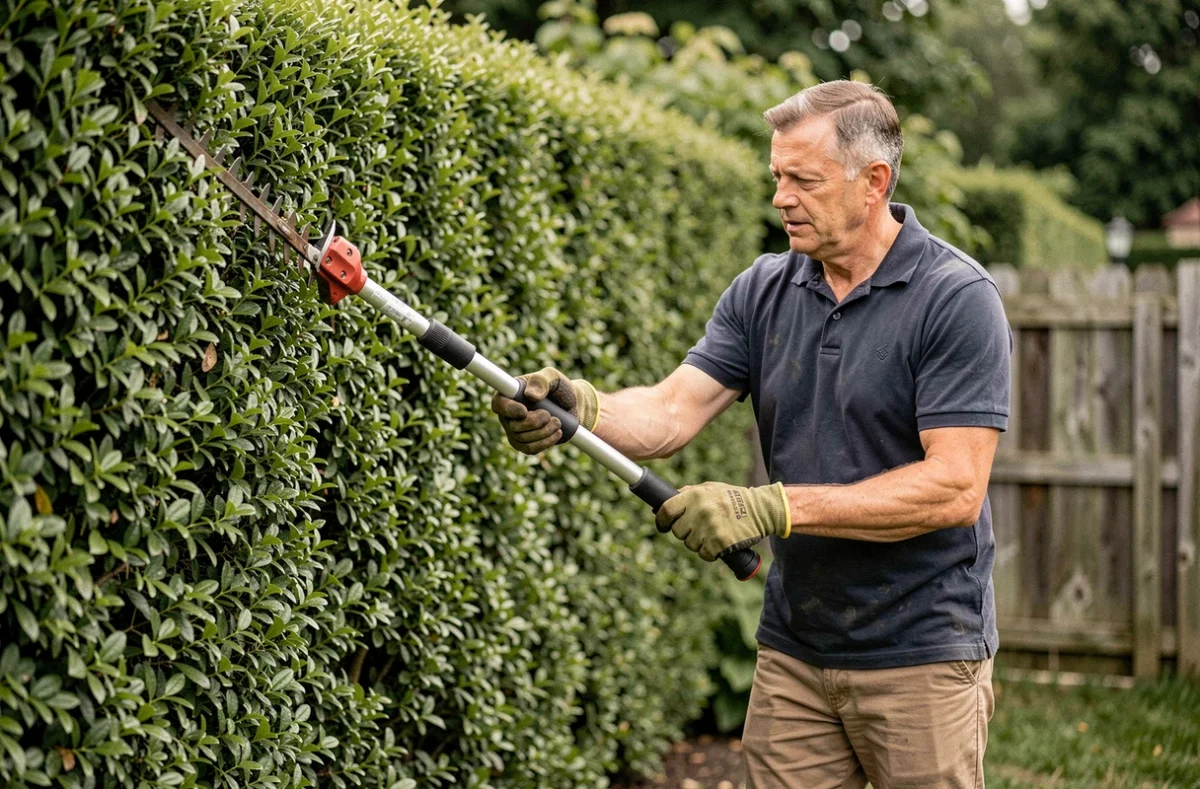
A telescopic hedge trimmer is not chosen like a classic model. The extension modifies the center of gravity, amplifies vibrations, and imposes mechanical constraints on the blade that most buying guides underestimate. Here we detail the technical parameters that make the difference between a tool usable for half a day and a regrettable purchase by the second session.
Motor torque and actual cutting diameter on a telescopic hedge trimmer
The power displayed in watts or volts says almost nothing about the effective cutting capacity at the end of the pole. What matters is the torque transmitted to the blade after the mechanical extension. On battery models, the nominal voltage (18 V, 36 V, 40 V) gives an indication of raw power, but the transmission through a shaft or cable along the pole generates significant mechanical losses.
We recommend relying on the spacing of the blade teeth rather than the motor power. A spacing greater than 16 mm allows for cutting semi-woody branches without forcing. Below that, the tool is suitable for regular maintenance trimming on soft shoots but struggles with a hedge of privet or hornbeam left unattended for several months.
Comparing the technical sheets of different models on taille-haie-telescopique.com allows you to check this spacing, which is rarely highlighted in stores.
Weight, balance, and muscle fatigue in high position
A telescopic hedge trimmer works with arms raised, often in lateral extension. The total weight of the tool is only part of the problem. The distribution of mass between the motor block (or battery) and the cutting head determines the actual effort felt by the user.
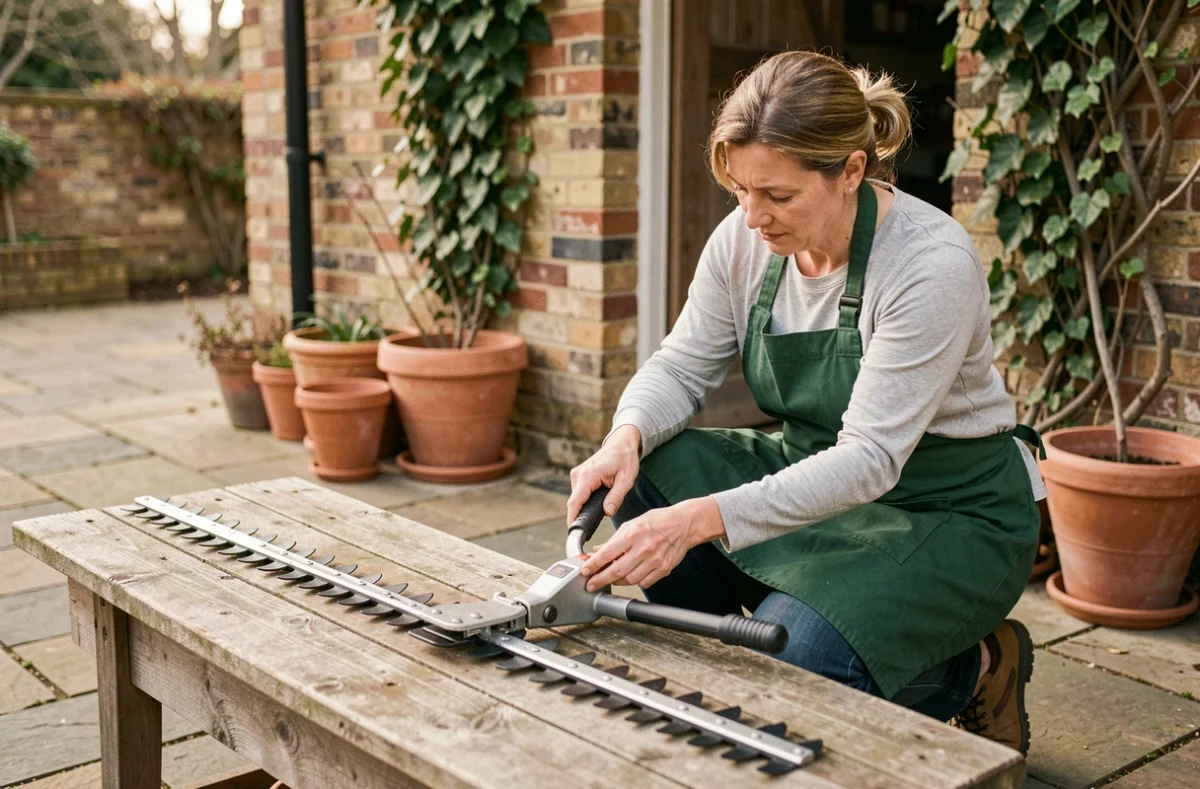
A poorly balanced tool tires twice as fast as a heavier but well-centered model. Serious manufacturers place the battery in a low position, near the handle, to bring the center of gravity closer to the operator. Entry-level models sometimes house the power unit in the middle of the pole, creating a disadvantageous lever effect as soon as the pole is tilted more than 45 degrees.
The shoulder harness is not an optional accessory. For sessions longer than an hour, it redistributes the load on the trunk and frees the forearms. Check that the harness attachment point is adjustable along the pole to adjust the balance according to the working angle.
Anti-vibration system
The vibrations transmitted to the hands and arms on a telescopic tool are amplified by the length of the pole. Models equipped with silent blocks or motor-pole decoupling systems significantly reduce joint fatigue. For frequent use, this criterion weighs as much as the weight.
Regulatory nesting constraint and blade choice
Prefectural orders prohibit hedge trimming over a wide period, often from March 16 to August 15, to protect birds during the nesting period. This constraint, rarely included in buying guides, has a direct impact on the choice of tool.
When trimming resumes at the end of summer, the hedge has grown for several months. The branches are harder and denser than after regular maintenance. A blade with double action and generous tooth spacing becomes necessary to handle this vegetation without clogging or overheating the motor.
- Single action blade: the lower knife remains fixed, the upper one oscillates. Cheaper, but generates more vibrations and leaves a less clean cut on hard wood.
- Double action blade: both knives move in opposite directions. Cleaner cut, reduced vibrations, better capacity on thick branches.
- Blade length: beyond 50 cm, precision decreases in high position. A blade of 40 to 50 cm offers the best compromise between reach and maneuverability on a telescopic pole.
We observe that users who only trim in September-October after the prohibition period should slightly oversize the cutting capacity compared to what regular use would suggest.
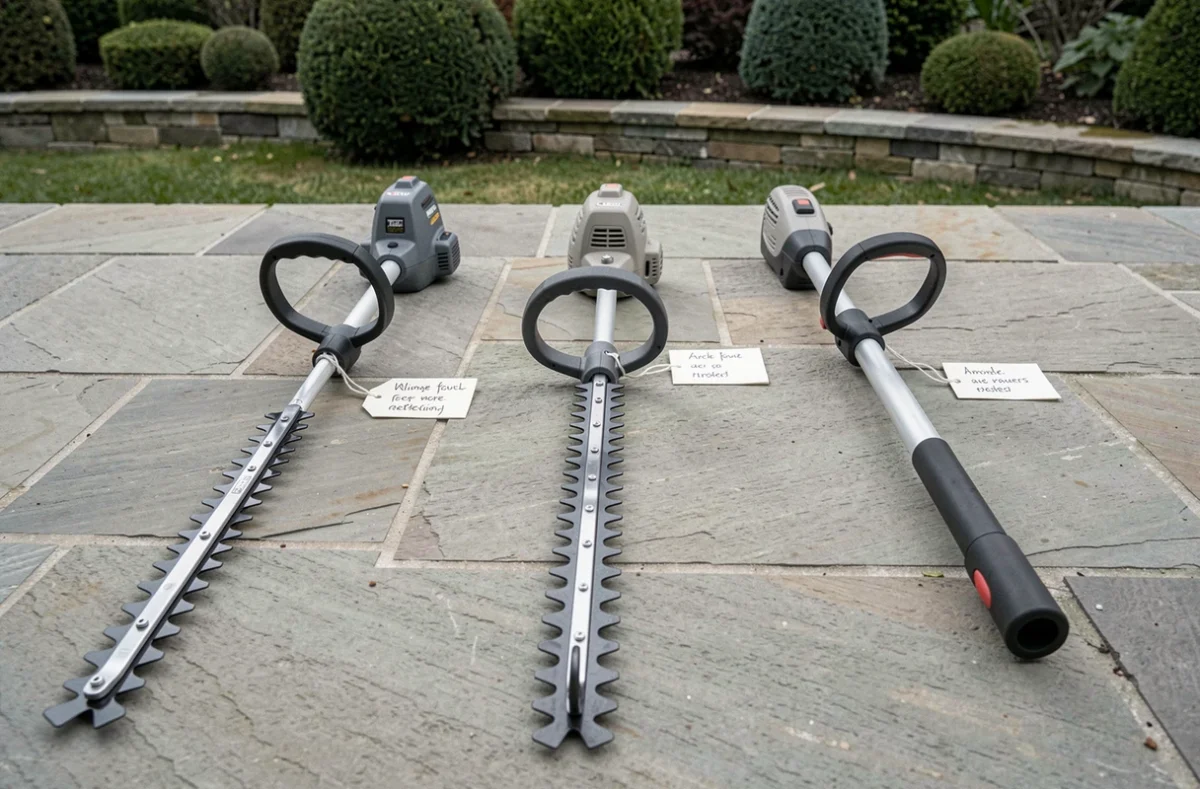
Battery, gas, or corded: which motorization for a pole hedge trimmer
The debate on motorization takes on a particular dimension with telescopic models, as weight and bulk are felt more acutely at height.
Battery models now dominate the residential segment. Their reduced noise level limits neighborhood conflicts in dense suburban areas, where the allowed hours for noisy work are increasingly regulated by municipal orders. A gas hedge trimmer can easily exceed the noise nuisance threshold, especially during prolonged use on weekends.
The gas option remains relevant for very long hedges or professional uses requiring unlimited autonomy. The corded option, while lightweight, requires an extension cord that becomes dangerous on a tool manipulated at height with a wide range of motion.
- Battery: prefer a voltage of 36 V or more to compensate for losses in the pole. Check compatibility with other tools in the same range to share batteries.
- Gas: reserved for significant linear lengths or very dense hedges in rural areas, where noise poses fewer constraints.
- Corded: acceptable only for small low hedges, close to a socket, where the telescopic pole is used in a nearly horizontal position.
Adjustable cutting head: a often decisive criterion
The ability to tilt the cutting head relative to the pole distinguishes a versatile tool from a limited one. An adjustable head by at least 90 degrees allows for trimming the top of a tall hedge without raising the pole vertically, which significantly reduces effort and improves precision.
The angle locking systems vary by manufacturer. Predefined notches (3 to 7 positions) are sufficient for most configurations. Continuous adjustment systems offer more flexibility but add a mechanism that may become loose over time.
The choice of a telescopic hedge trimmer ultimately rests on three parameters to cross-reference: the spacing of the teeth relative to the hardness of the hedge, the weight balance of the tool in high position, and the motorization suited to the concentrated frequency of use that the nesting regulation now imposes.